
How Long Does a Metal Roof Last in Texas
Metal roofing shows up on more Permian Basin homes and shops every year, and the first question most owners ask is how long the investment actually lasts. The short answer is 40 to 70 years for a quality standing seam system and 25 to 40 years for an exposed fastener panel. Texas sun, hail, and wind all push those numbers around, sometimes by a decade or more. Panel design, coating chemistry, metal gauge, and installation quality matter as much as the brand name printed on the shipping label. A thin panel installed over soft decking will not reach half of its rated life, and no warranty will change that. A properly installed system with the right underlayment and flashing details can easily outlive the mortgage on the building it protects. Knowing what drives the difference helps you spend the money once instead of twice. Owners in Odessa, Midland, Andrews, and the surrounding towns face a specific mix of heat, blowing dust, and storm exposure that changes the math compared to the rest of the state.
How Long a Metal Roof Lasts in Texas by Panel Type
Not every metal roof is built the same, and lifespan tracks closely with panel design. Two systems dominate the Texas market: standing seam and exposed fastener. Standing seam hides the fasteners underneath raised ribs that are either snapped together or mechanically seamed in the field. Exposed fastener panels, usually sold as R panel or U panel, screw straight through the face of the metal into the deck or purlin below. Both systems perform well when installed correctly; they simply age differently and fail on different timelines. Coating chemistry, metal gauge, and the base metal itself shift the expected life by decades. A 29 gauge panel with a basic polyester paint and a 24 gauge Galvalume panel with a PVDF finish are not the same product, even though they look similar from the driveway. Price usually tells you which one you are being quoted.
How Long a Standing Seam Metal Roof Lasts in Texas
A standing seam metal roof installed on a Texas home commonly lasts 40 to 70 years. The panels are attached with concealed clips, so nothing punctures the water shedding surface of the metal. Those clips are the reason the system handles heat so well; many of them are designed to float, letting the panel slide as it expands and contracts through the day. Most residential systems use 24 gauge or 26 gauge steel, with 24 gauge being the thicker and more durable of the two. Galvalume coated steel, which uses an aluminum and zinc alloy layer, resists corrosion far better than older galvanized products. Paint systems built on PVDF resin, sold under names like Kynar 500 and Hylar 5000, carry finish warranties in the 30 to 40 year range against chalking, fading, and peeling. Aluminum and copper panels last even longer but carry a price tag most Permian Basin owners never need to pay. The dry climate here works in your favor, since corrosion accelerates in humid coastal air.
The absence of face fasteners removes the most common leak point on any metal roof. Every screw driven through a panel is a hole that depends on a rubber washer to stay dry, and standing seam simply does not have those holes across the field of the roof. Seam style matters as well; mechanically seamed panels, which are folded closed with a powered seaming tool, hold up better under high wind than snap lock profiles. Wind uplift testing under UL 580 and UL 1897 gives you a real number to compare instead of a sales claim. Panel length also plays a role, because longer runs move more with temperature swings and need clips rated for that movement. Standing seam typically costs two to three times what an architectural shingle roof costs to install. The tradeoff is fewer service calls, fewer replacements over your ownership period, and better performance in high wind events. For owners planning to stay in a home for decades, the numbers usually work out.
Panels are rarely the first component to wear out on a standing seam roof. Underlayment, sealants, pipe boots, and flashings all age faster than the metal above them. Sealant inside seams and at transitions has a service life closer to 15 or 20 years and needs inspection well before the panels show any wear. Penetrations for plumbing vents, evaporative coolers, and HVAC curbs are the usual sources of leaks on an otherwise healthy roof. Oil canning, the slight waviness visible across flat panel areas, is a cosmetic characteristic of light gauge metal and is not a defect or a leak risk. Fasteners at eaves, rakes, and ridge caps should be checked after major storms, since edge metal takes the worst of the uplift pressure. A roof that gets inspected every couple of years will reach the top of its expected range. One that gets ignored for 30 years will not.

How Long an Exposed Fastener Metal Roof Lasts in Texas
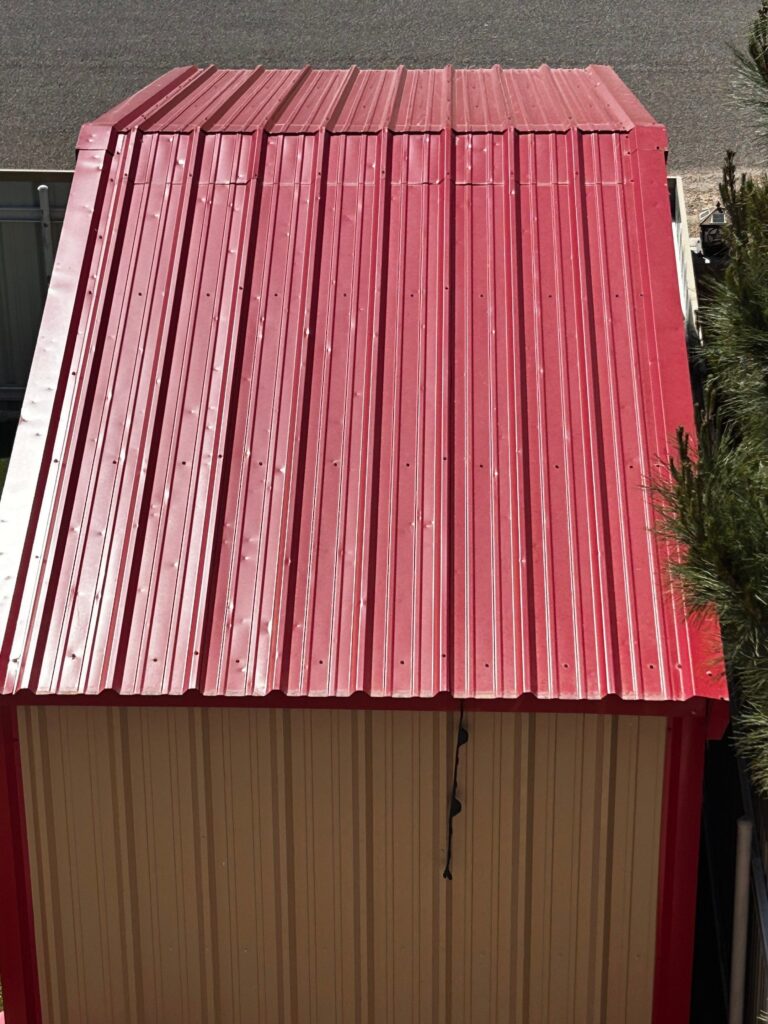
Exposed fastener metal roofing lasts 25 to 40 years in Texas, and the low end of that range is common when maintenance gets skipped. These panels are held down by screws driven through the face of the metal, each one sealed by a bonded rubber washer. A typical house can carry several thousand of those screws. The washers are usually EPDM or neoprene, and ultraviolet exposure breaks them down long before the steel itself gives out. Most washers begin to harden, crack, and shrink somewhere between year 15 and year 20 in this climate. Once a washer fails, water tracks down the screw shank and into the decking, often without any visible ceiling stain for months. Screws can also back out slowly as the panel expands and contracts through daily heat cycles. Retightening or replacing fasteners is normal maintenance on this system, not a sign of a defective roof.
Thermal movement is the underlying problem with any through fastened panel. Steel expands and contracts measurably across a long run, and the screw holds the panel rigidly in one spot while the metal tries to move around it. Over years, that motion enlarges the hole and turns a round opening into an oval one. Panels in 26 gauge or 29 gauge are more prone to this than heavier material because they flex more readily. That is one reason exposed fastener systems are so common on barns, shops, and agricultural buildings, where a small leak carries less consequence than it does above a living room ceiling. On steeper residential slopes with clean details, these roofs still perform for decades at a fraction of the cost of standing seam. The savings are real; the maintenance obligation is real too. Owners who understand both usually get good service out of the system.
A maintenance plan is what separates a 25 year exposed fastener roof from a 40 year one. Plan on a fastener inspection around year 12 and a full screw replacement using larger diameter screws when the washers reach the end of their life. Sealant at end laps, ridge caps, and sidewall flashings should be checked at the same time and renewed as needed. Cut edges deserve attention as well, since field cutting exposes bare steel that can develop rust creep along the trim line. Cutting panels with an abrasive saw is a common installation mistake, because the hot filings it throws land on nearby panels and rust in place, leaving orange freckles across a new roof. Sweeping the roof clean after installation prevents that entirely. Closure strips at the eave and ridge keep wind driven dust and blowing rain out of the panel ribs. Small details like these determine how the roof looks and performs in year 20.
How Long a Metal Roof Lasts in Texas Compared to Asphalt Shingles
Asphalt shingles remain the most common roof covering in West Texas, and a quality architectural shingle typically delivers 20 to 30 years here. Heat is the main limiting factor, since asphalt loses volatiles as it bakes and the mat underneath becomes brittle with age. Granule loss accelerates that process by exposing the asphalt layer directly to ultraviolet light. Daily thermal cycling of 40 degrees or more in spring and fall works the material hard. Three tab shingles age faster than laminated architectural products and are rarely worth installing on a home you plan to keep. Impact rated shingles carrying a UL 2218 Class 4 designation hold up better against hail and often earn an insurance discount. Metal generally doubles the service life you get from asphalt in this climate. That advantage comes with a higher price at the time of installation.
The honest way to compare the two materials is cost per year of service. A shingle roof replaced twice over 50 years may cost more in total than one metal roof installed correctly the first time, once you account for labor, tear off, disposal, and the price of materials rising over that span. Metal also brings energy benefits that matter in a place with long cooling seasons; reflective finishes reject a large share of solar radiation instead of absorbing it into the attic. Insurance carriers frequently treat metal favorably for fire resistance and wind performance. Resale value tends to hold up well, particularly for standing seam. On the other side of the ledger, a metal roof requires more skill and specialized tooling to install, which narrows the field of contractors who should be touching it. Repairs to a single damaged panel are harder than swapping a few shingles. Neither material is universally correct.
Hail is the one factor that makes many Permian Basin owners choose shingles instead. Metal panels resist puncture very well, but they dent, and a dented roof is still a functioning roof. Many Texas policies now carry cosmetic damage exclusions or waivers, which means an insurer may decline to pay for dents that do not affect performance. Reading your policy before choosing a material saves a difficult conversation later. Roof slope matters too, since most metal panel systems need a minimum pitch and low slope areas call for a different approach entirely. Decking condition, ventilation, and structural capacity all factor into the decision as well. PB Roofing is a preferred contractor for IKO and Owens Corning, so a shingle system from us comes with strong manufacturer backing when that is the better fit for your home. Ready to compare roofing materials for your property? Click here for our roof replacement service.
What Shortens How Long a Metal Roof Lasts in West Texas
Rated lifespan assumes ideal conditions, and West Texas rarely provides them. Surface temperatures on a dark metal panel can climb well past 150 degrees on a July afternoon in Odessa. Ultraviolet exposure here is intense and relentless across long summers. Wind events regularly push past 50 miles per hour, and spring hail season brings its own risks. Blowing dust and sand scour finishes and pack into panel ribs and gutters. Low humidity actually helps by slowing corrosion, which is one advantage this region holds over the Gulf Coast. What remains within your control is the quality of the materials specified and the quality of the hands installing them. Those two factors decide more about longevity than the weather does.
How Texas Heat and Sun Affect How Long a Metal Roof Lasts
Heat drives constant movement in every metal roof. Steel expands roughly one eighth of an inch per 20 feet of panel for every 100 degree change in temperature, and panels routinely swing from 70 degrees at dawn to 160 degrees by mid afternoon. A standing seam system absorbs that motion through floating clips and properly slotted fastener holes. An exposed fastener system fights it, which is why screws loosen and holes elongate over the years. Panel length, clip spacing, and fastener type all need to account for expected movement at the time of installation. Ignoring thermal design is one of the most common mistakes on long panel runs. The symptom shows up years later as squeaking, buckling, or persistent leaks near the middle of a slope. Correct detailing at the start prevents all of it.
Ultraviolet light attacks the paint finish rather than the steel. Lower cost coatings built on silicone modified polyester perform acceptably but chalk and fade faster under heavy sun exposure. PVDF finishes hold color and gloss much longer and carry warranties that spell out maximum allowable fade in Hunter units. Dark colors absorb more heat and generally show fade sooner than light ones. Reflective cool roof pigments reduce attic heat gain substantially, which lowers cooling costs and takes stress off the decking and underlayment below. Energy Star listed metal finishes are widely available and add little to material cost. South facing and west facing slopes always weather faster than north facing ones, so uneven color across a roof after 20 years is normal. Choosing a proven finish at the outset is the cheapest longevity upgrade available.
What sits under the panel matters as much as the panel itself. Standard organic felt underlayment dries out and crumbles under the heat trapped beneath metal, sometimes within a decade. High temperature peel and stick underlayment rated to 250 degrees is the right specification for a metal roof in this region. Synthetic underlayments rated for metal applications also perform well and resist tearing during installation. Since the underlayment is your true secondary water barrier, replacing it means removing the entire roof, so it should be specified to match the panel life. Attic ventilation reduces the heat load on both the underlayment and the decking, extending the service life of everything in the assembly. Ridge vents, intake at the eaves, and a balanced ventilation calculation all contribute. Skipping these details to save a few hundred dollars costs far more in the long run. Planning a new metal or shingle system? Click here for our roof installation service.
How Hail and Wind Affect How Long a Metal Roof Lasts in Texas
The Permian Basin sits inside an active hail corridor, and spring storms drop stones large enough to damage any roof covering. Metal handles hail better than most materials in terms of function, since panels rarely puncture even under significant impact. Denting is the real concern, and thinner gauges dent more visibly than heavier ones. A 24 gauge panel resists cosmetic damage noticeably better than a 29 gauge product. Some metal systems carry a UL 2218 Class 4 impact rating, which is the top classification available. Textured or striated panel profiles also disguise minor denting better than smooth flat pans. Function and appearance are separate questions after a hail event, and your insurance policy may treat them separately as well. Reviewing your coverage for cosmetic damage language before a storm is a smart move.
Wind failures on metal roofs almost always begin at the edges. Eave trim, rake trim, and ridge caps take the highest uplift pressure during a storm, and once wind gets under a loose edge it can peel a large section. Properly fastened perimeter metal, correct clip spacing near the edges, and full seam engagement across the field are what keep a roof attached. Manufacturers publish tested uplift ratings, and those ratings only apply when the system is installed exactly as tested. Substitute fasteners, wider clip spacing, or missing closures all void that performance. Blowing dust packs into ribs, gutters, and valleys, holding moisture against the metal and creating slow corrosion sites. Clearing debris once or twice a year prevents that buildup. Loose fasteners found early cost very little to correct.
After any major storm, a metal roof deserves an inspection even when nothing looks wrong from the ground. Loose or backed out screws, displaced ridge caps, separated seams, and damaged flashing are all common and all easy to miss from the driveway. Punctures from wind driven debris happen more often than hail punctures do. Documentation matters if a claim becomes necessary, since insurers want dated photographs and a clear scope of damage. Waiting months to report storm damage often complicates a claim, because most policies require prompt notice. A small repair completed quickly protects the decking and insulation underneath. Damage left open through a wet season turns a simple fix into a partial replacement. Storm damage on your roof? Click here for our roof repair service.
How Installation Quality Decides How Long a Metal Roof Lasts in Texas
Most metal roofs that fail early do not fail because of the panels. They fail at valleys, transitions, sidewall flashings, chimneys, and penetrations, which is exactly where craftsmanship shows. Valley details need adequate width, correct hem, and enough clearance for panels to move without binding. Sidewall and headwall flashings must be counterflashed properly rather than sealed with caulk and hope. Pipe penetrations need boots rated for high temperature service, since standard boots harden and split under a metal roof. Every one of these details is invisible from the ground and expensive to correct later. Manufacturers publish installation manuals for a reason, and warranties depend on following them. A crew that installs metal every week catches these things automatically.
Fastener work is another area where small errors compound over decades. Overdriving a screw crushes the washer and destroys the seal it was meant to create; underdriving leaves a gap. Screws must land in solid decking or purlins, not in the gap between them, and missed fasteners left in place become leak points. Using the wrong screw material next to the wrong panel material causes galvanic corrosion where dissimilar metals meet. Direct contact between steel panels and treated lumber, copper flashing, or masonry can also drive corrosion at the contact point. Panels should be cut with shears or a nibbler rather than an abrasive blade, and metal filings need to be swept clear the same day. None of this shows up during the final walk with the homeowner. All of it shows up in year 15.
Substrate condition sets the ceiling on any roof system. Soft, delaminated, or water damaged decking will not hold fasteners, and installing new metal over it guarantees problems. Decking should be inspected, and replaced where needed, before any panel goes down. Fastener pull out values depend entirely on sound wood, which is why deck evaluation belongs in every honest estimate. Existing layers, ventilation, and framing capacity all deserve a look at the same time. A contractor who quotes a metal roof without going into the attic or evaluating the deck is guessing. Manufacturer warranties frequently exclude failures traced back to substrate issues or installation shortcuts. Paying for the inspection work up front is far cheaper than paying for the consequences.
Why You Need a Local Roofing Company to Get the Full Life From a Metal Roof
Roofing decisions in the Permian Basin need to account for conditions that a contractor from out of state simply does not know. Heat, dust, wind, and hail here behave differently than they do in East Texas or Oklahoma. A local company knows which systems perform in this climate and which ones look good on paper only. PB Roofing works across Odessa, Midland, Andrews, Big Spring, Monahans, Pecos, Seminole, Kermit, Lamesa, and Fort Stockton, and we see the same failure patterns repeat across every one of those towns. Getting the material choice, the underlayment, and the flashing details right is what turns a rated lifespan into an actual one. Free estimates make it easy to get real numbers before committing.
Why a Free Roof Inspection Protects the Life of Your Metal Roof
An inspection catches the small problems that quietly shorten a roof’s life. Loose fasteners, cracked sealant, deteriorated pipe boots, and separated seams are all inexpensive to correct while they are still minor. Left alone, each of those items eventually soaks decking, insulation, and framing. Water inside a roof assembly does damage that costs many times more than the repair that would have prevented it. Regular inspections also build a record of your roof’s condition, which helps considerably if you ever file an insurance claim.
PB Roofing provides a free, no obligation estimate on every project, including inspections after storms. There is no charge to find out what condition your roof is actually in. We photograph what we find and explain it in plain language rather than handing over a report full of jargon. If the roof is fine, we say so and move on. Honest answers cost us nothing and earn long term customers.
Timing matters with roof inspections in West Texas. The best windows are after spring hail season and again ahead of winter, when small openings become bigger problems. Homes with metal roofs older than 15 years should be checked more frequently, since fastener washers and sealants are reaching the end of their service life around that point. New buyers should always have a roof evaluated before closing, because a roof at the end of its life changes the value of a transaction. An hour of inspection can add years of service.
Why Fast Roof Repair Extends the Life of a Metal Roof in Texas
Metal roofs give warning signs before they fail outright. Streaking rust at a cut edge, a screw standing proud of the panel, a lifted ridge cap, or a stain on an interior ceiling all point to something correctable. Addressing those signs early keeps the repair confined to a small area. Waiting turns a fastener problem into a decking problem, and a decking problem into a framing problem. Insulation that gets wet loses its performance permanently and needs replacement.
Repairs on metal require the right materials, not just any sealant from the shelf. Butyl tape, compatible fasteners, matching gauge and finish, and proper closure strips all matter for a repair that lasts. Mismatched materials create new corrosion points and often make the second repair harder than the first. Our crews stock the correct components and match the existing system as closely as available product allows. Doing a repair once is always cheaper than doing it three times.
PB Roofing applies full credit from any roof repair toward a future replacement. Money spent keeping your current roof going is not money wasted when the time eventually comes to replace it. That policy exists because we would rather repair a roof that has life left than sell a replacement that is not needed yet. Owners deserve straight guidance about how much service remains in what they already own. Need a repair on your existing roof? Click here for our roof repair service.
Why Choose PB Roofing for Metal Roof Work in Texas
PB Roofing holds an A plus rating with the Better Business Bureau, which reflects how we handle both the work and the follow up. We are a preferred contractor for IKO and Owens Corning, and we carry that same standard of workmanship into every system we install. Our estimates are free, with no obligation and no pressure to sign anything on the spot. We explain the condition of your decking, your ventilation, and your flashings instead of quoting only the surface material. Owners make better decisions when they have the full picture.
Every replacement job we complete carries a four year labor warranty on top of the manufacturer’s material coverage. Material warranties protect against product defects; labor warranties protect against installation problems, and installation is where most roofs actually fail. Standing behind our own work for four years keeps our crews focused on the details that matter. We are based right here in Odessa, so we are available when a question comes up next year or five years from now. Local accountability is worth more than a national brand name on a truck.
Metal roofing is a long commitment, and the contractor you choose determines how much of that rated lifespan you actually receive. We will give you an honest assessment of your options, including recommending a shingle system when that fits your budget and your risk tolerance better. Serving Odessa, West Odessa, Midland, Andrews, Big Spring, Monahans, Pecos, Seminole, Kermit, Lamesa, and Fort Stockton, PB Roofing is ready to look at your roof and give you real numbers. Call us at (432) 853-7270 or email sean@roofingpb.com to schedule your free estimate. Ready to move forward with a new roof? Click here for our roof installation service.